SIMULACRUM
Test Your Constellation Before It Reaches Orbit
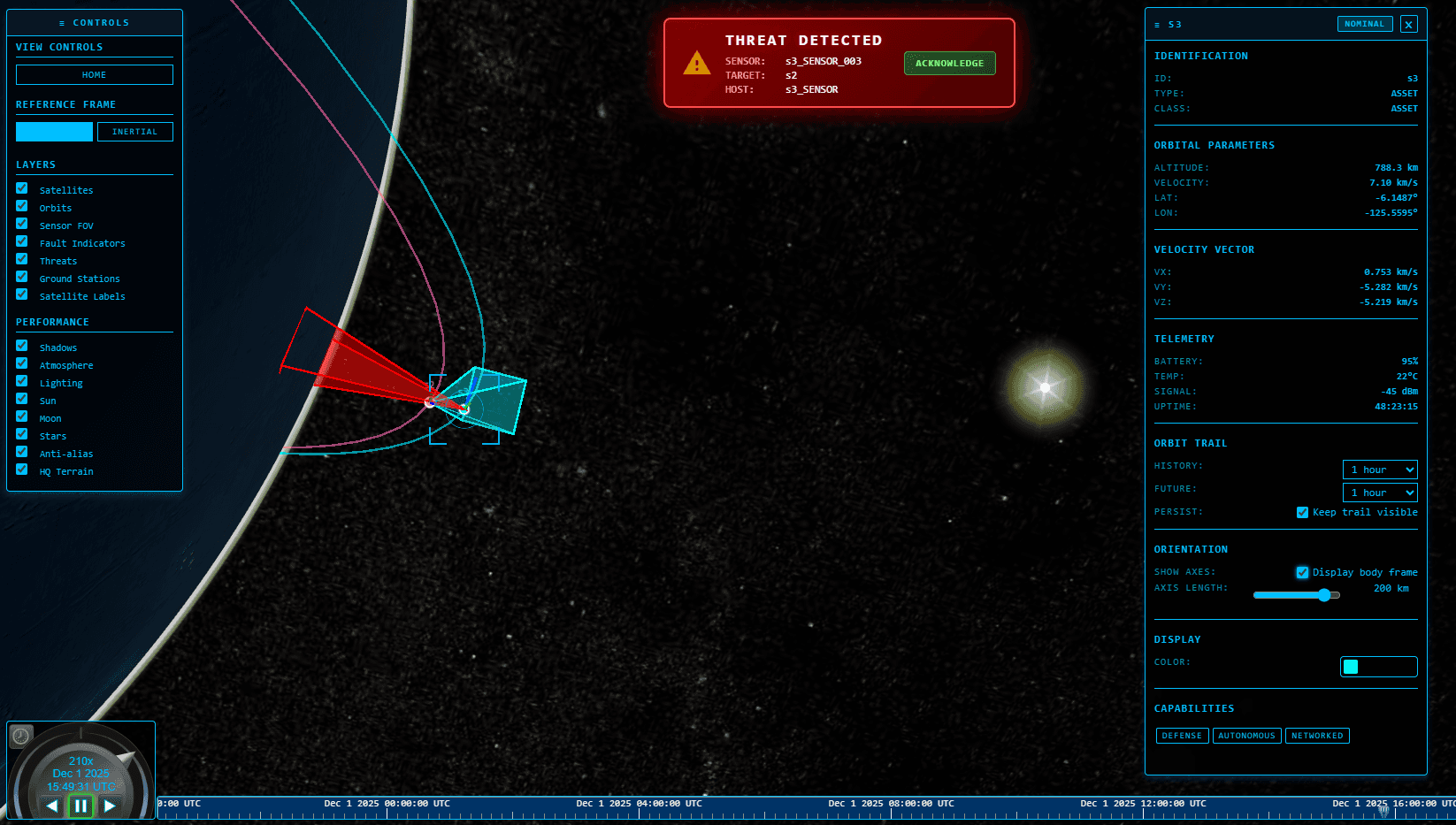
How does your constellation handle a conjunction cascade, a sensor anomaly, or an electronic warfare attack during a ground-link gap? SIMULACRUM answers that question with full-fidelity simulation — real physics, real autonomy, real operational scenarios. The environment is active and available for demonstration today. Prove it works before it flies.
WHAT SIMULACRUM DOES
Throw Everything at It
Inject realistic scenarios across 20+ categories — RPO, directed energy, electronic warfare, anomalies, and more. See exactly how your constellation responds.
Full Fleet, Full Fidelity
Simulate 10 to 1,000+ satellites with realistic communication delays, orbital mechanics, and autonomous coordination. No shortcuts.
Weeks of Ops in Hours
Compress entire orbital campaigns into a single session. Pause at any point. Step through decisions. Replay and analyze.
Real Physics, Not Approximations
Physics-based sensor models with realistic detection curves, noise characteristics, and environmental conditions. The simulation earns your trust.
Rehearse the Mission
Run the complete autonomous pipeline against contested scenarios end-to-end. Know exactly how your constellation behaves before it ever reaches orbit.
Prove It, Then Prove It Again
Automated regression campaigns validate every classification category, every response type, every edge case. Continuous confidence in system behavior.
Simulation Views
Full-Fidelity Visualization
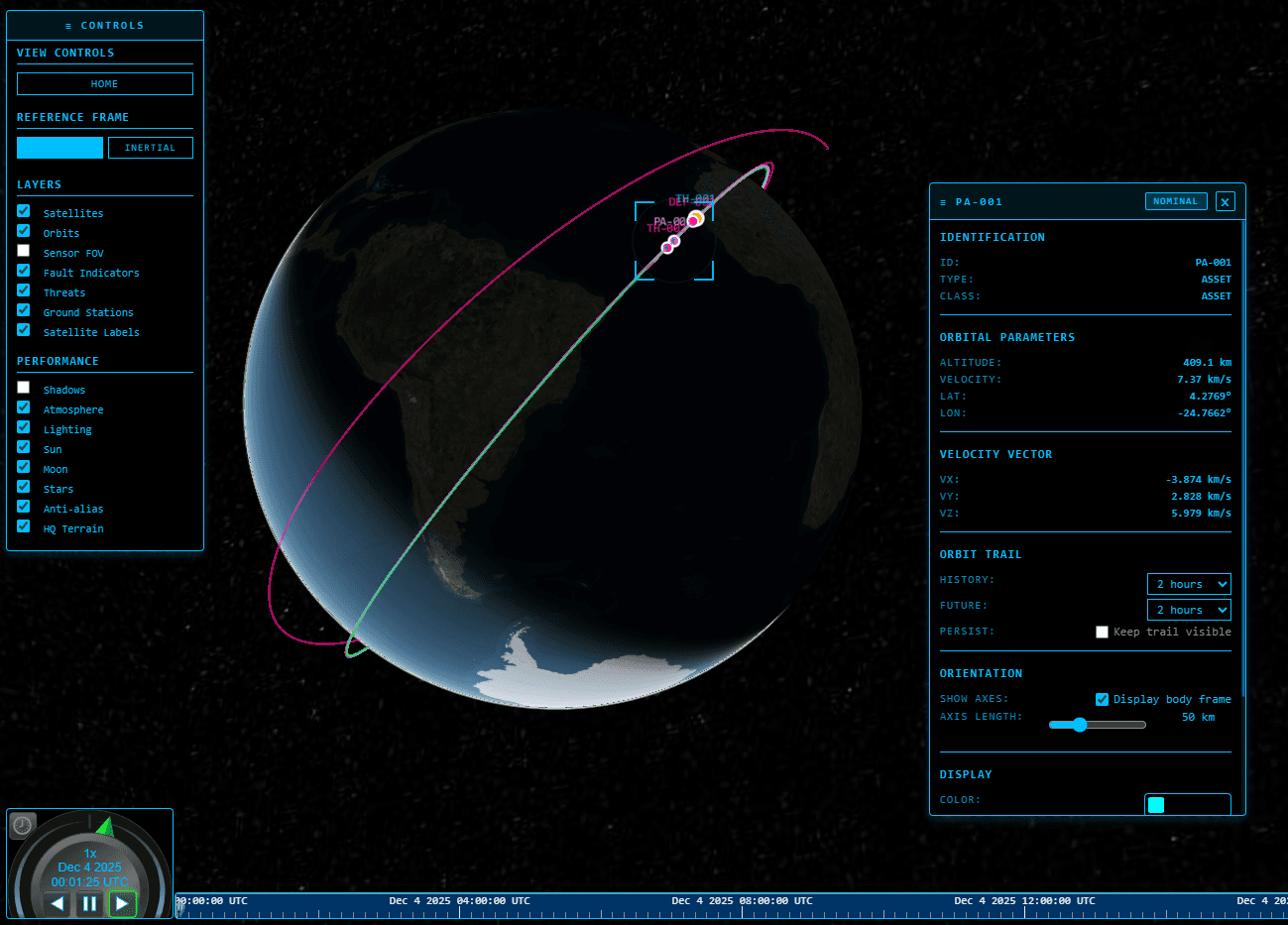
Orbital tracking with real-time state estimation
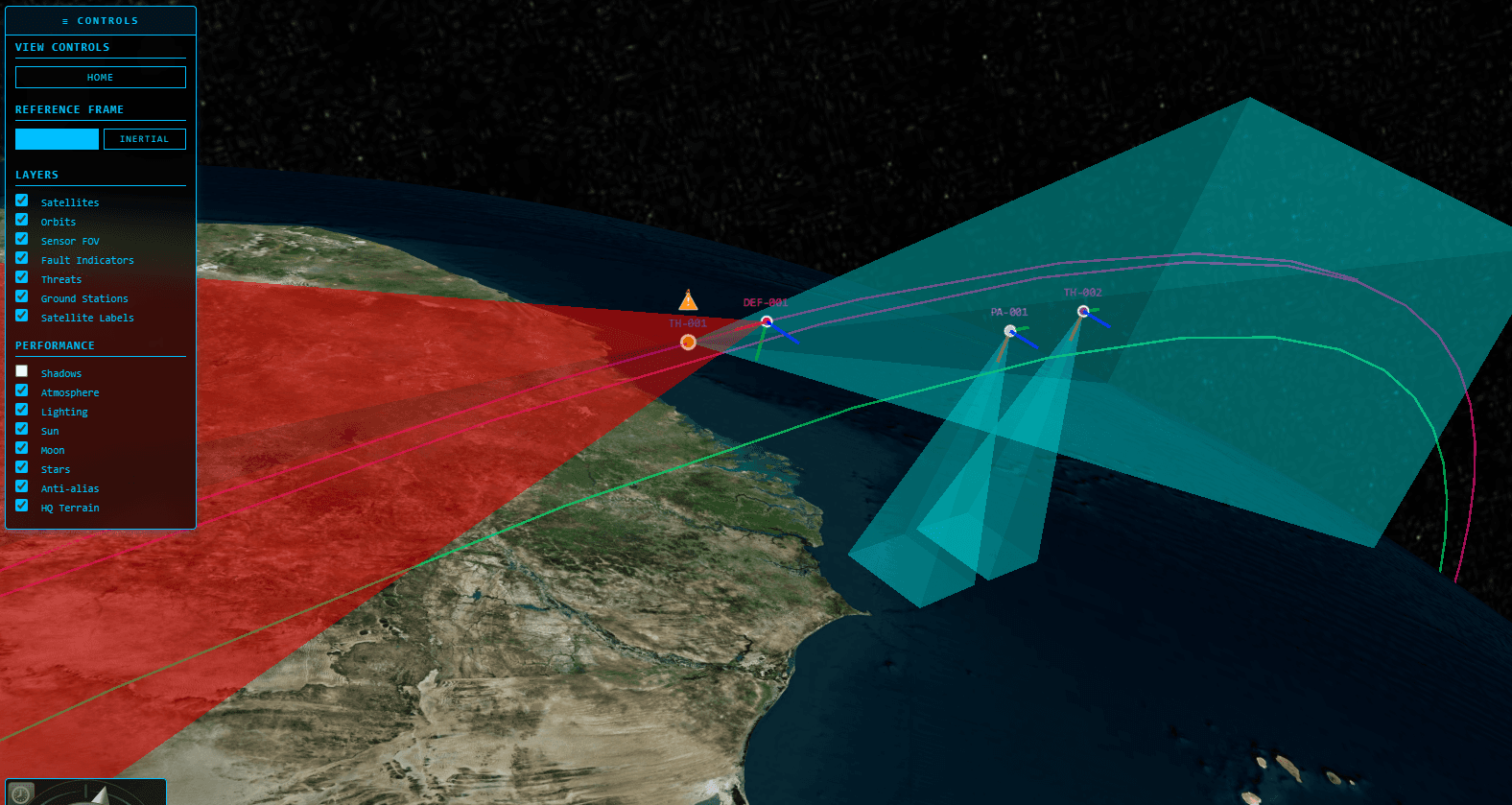
Constellation sensor coverage and coordination
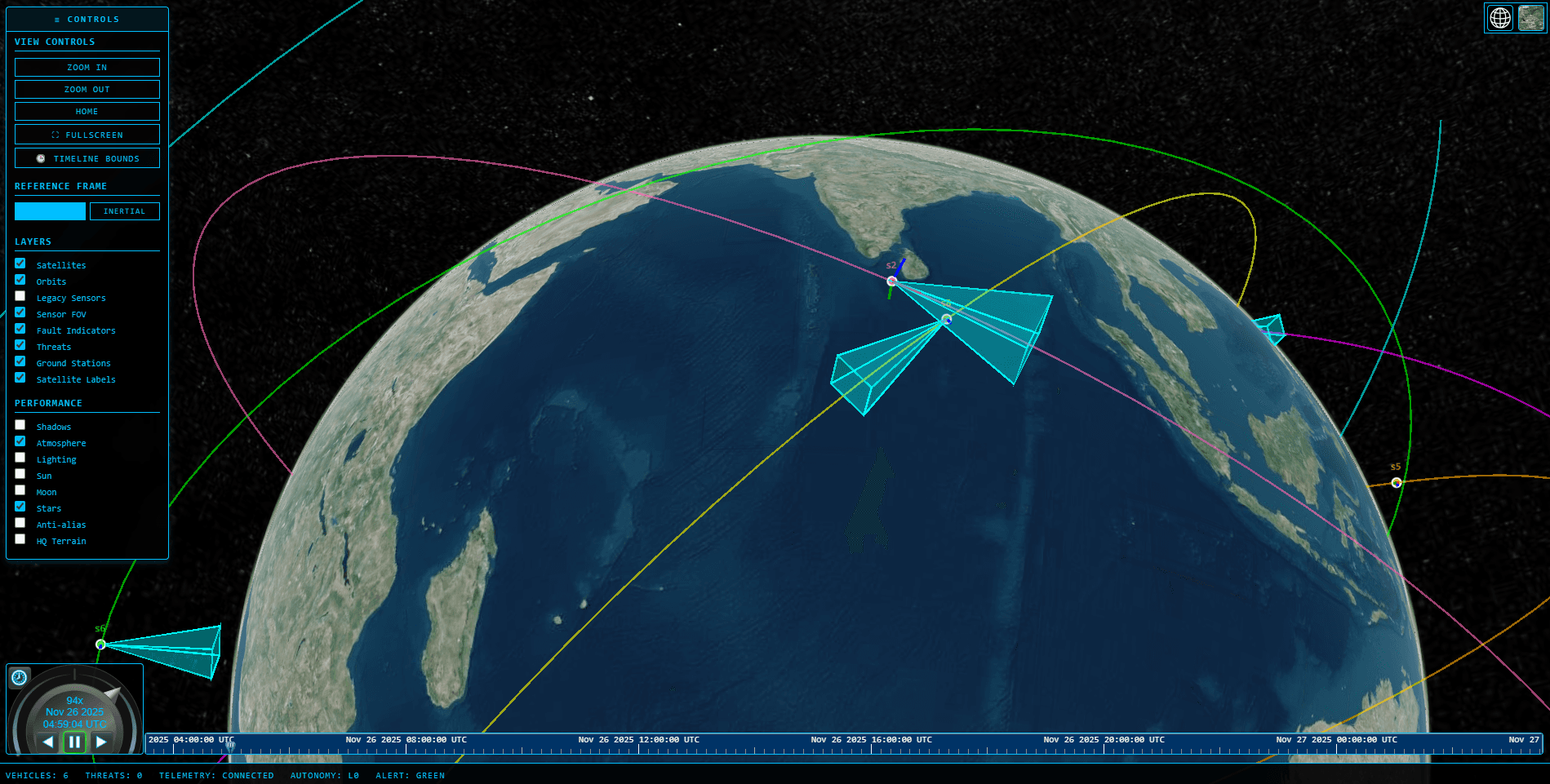
Multi-orbit constellation visualization
Fidelity
What Gets Simulated
Orbital Mechanics
High-fidelity orbit propagation with atmospheric drag, solar pressure, and gravitational perturbations.
Sensor Environment
Physics-based sensor models with realistic detection probability, noise characteristics, and coverage geometry.
Scenario Library
Configurable scenario injection across all 20+ categories — threats, anomalies, and operational events — with realistic profiles and timelines.
Fleet Communication
Realistic inter-satellite link delays, message loss, and distributed coordination under degraded conditions.
Autonomous Response
Complete autonomous detection-to-response pipeline execution using live orbital state data.
Communication Gaps
Configurable ground-link interruption windows — from orbital position gaps and latency to active denial — to validate autonomous operations under realistic conditions.
Topology
Every Satellite. Every Decision. Simulated.
This isn't a simplified model. SIMULACRUM instantiates every satellite with its own autonomous pipeline — detection, classification, response selection, fleet coordination. Exactly what runs in orbit runs in simulation. This is the same multi-satellite coordination and task allocation environment referenced in our technical demonstrations — live, operational, and ready for evaluation.
Validation
Every Classification Category. Validated.
Automated regression campaigns exercise every classification category — verifying that SYNAPSE classifies correctly and responds appropriately, every time.
Find out how your constellation handles the worst day in orbit.