YOURCONSTELLATIONTHINKSFORITSELF
The control plane for the orbital economy. Distributed orchestration that turns thousands of satellites into a single, coordinated system.
The Problem
The Scaling Paradox
Thebottleneckhasshiftedfromlaunchtooperations.Launchisacommodity.Hardwareismass-produced.Butoperatorsaremanagingmassiveconstellationswithlegacytechnologyneverdesignedforthisscale.Centralizedgroundcontrolscaleslinearlywhilefleetcomplexitygrowsexponentially.The'coordinationtax'hasbecometheprimaryconstraintonmissionROI.
The Solution
SYNAPSE
SYNAPSE is a modular coordination layer that distributes operational authority to the edge. It deploys alongside your existing flight software — no rip-and-replace, no rewriting spacecraft code. Your fleet negotiates execution in orbit, maintains its own state, and coordinates resources autonomously. Ground links become a convenience, not a dependency.
How It Works
From Detection to Response in Seconds
DETECT
See Everything
The constellation is a distributed sensor network. Optical, RF, and electronic intelligence streams fuse into a single, real-time orbital picture — continuously, across every node.
Multi-SourceCLASSIFY
Know What It Is
On-board ML classifies what the constellation is seeing across 20+ categories — threats, anomalies, and operational events. No ground input. No waiting. The system knows what's happening and how to respond.
20+ CategoriesDECIDE
Choose the Response
The right operational response is selected in sub-seconds based on event classification, orbital geometry, and what the rest of the fleet is doing.
Sub-SecondACT
Move as One
The entire constellation aligns on a coordinated response in under four seconds. Every node acts as part of a unified system — whether ground links are available or not.
<4sBy The Numbers
The Numbers Behind the Shift
Ground sets mission intent. SYNAPSE ensures execution continues — whether the link is up, degraded, or actively denied. This is distributed execution with deliberate oversight.
The system scales logarithmically. Adding satellites increases capability, not complexity. The same architecture that coordinates 10 nodes handles a thousand — no additional ground infrastructure, no additional operators.
One platform serves defense, commercial, and insurance markets. Same core, different configurations. No code changes between applications.
Built for Government & Defense
Operator Interface
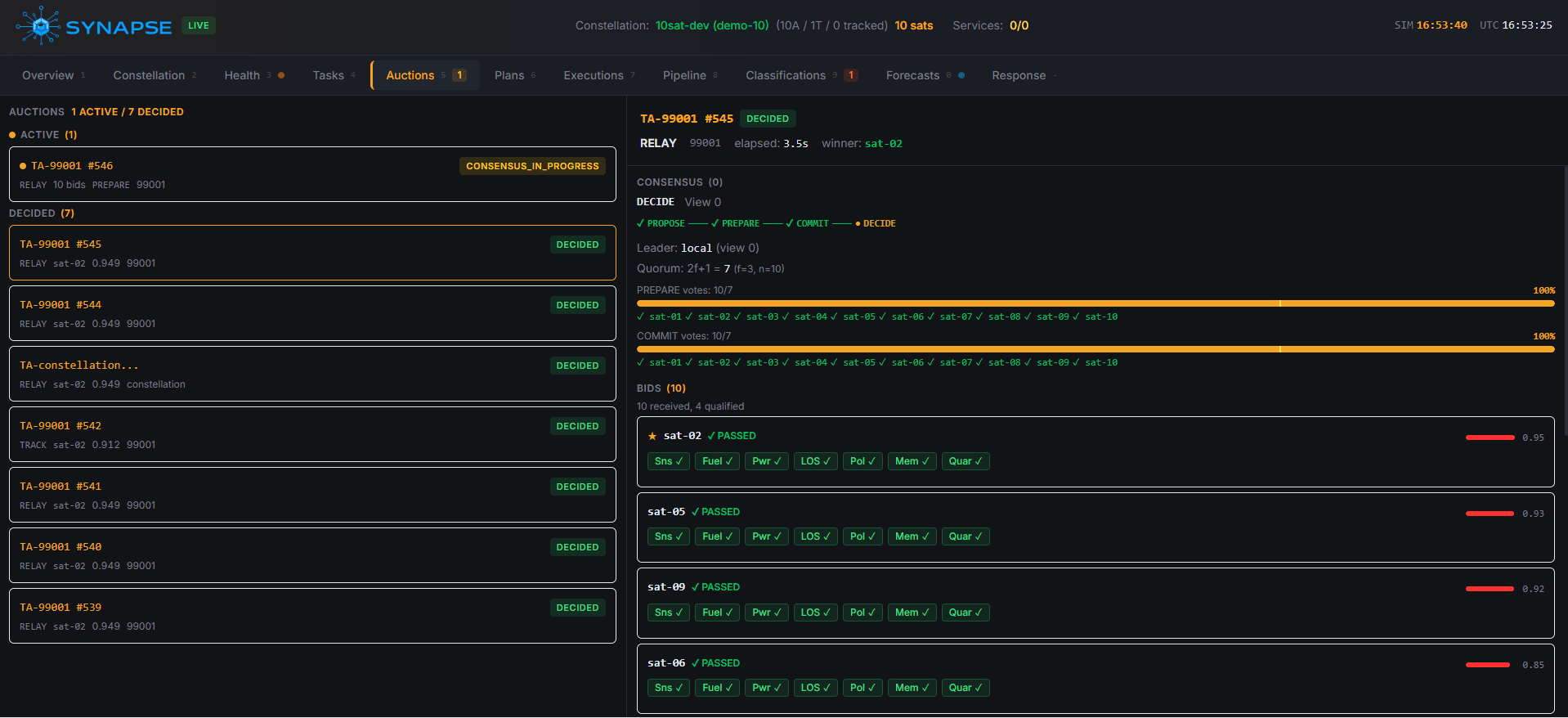
Four operational views give operators complete visibility into constellation health, event classification, and autonomous decisions — with full override capability.
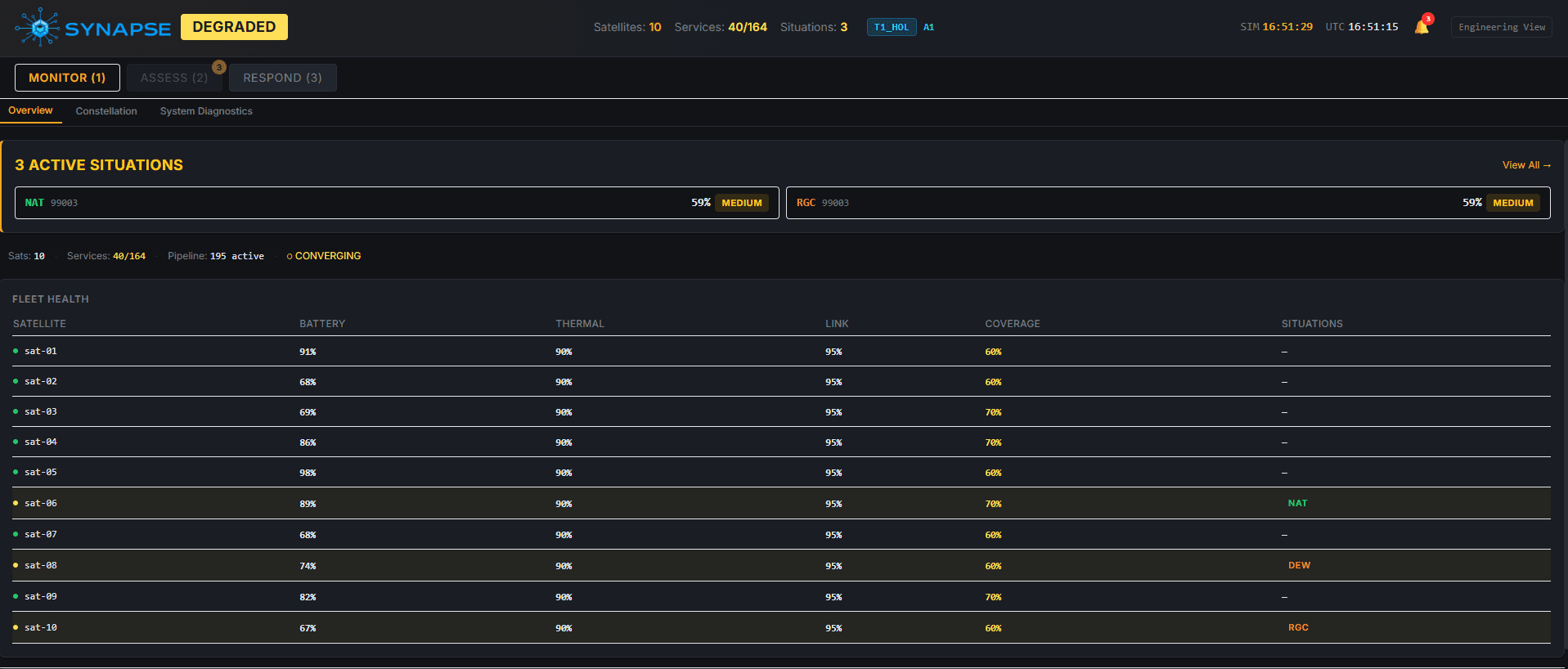
Fleet Monitor — Real-time satellite health matrix
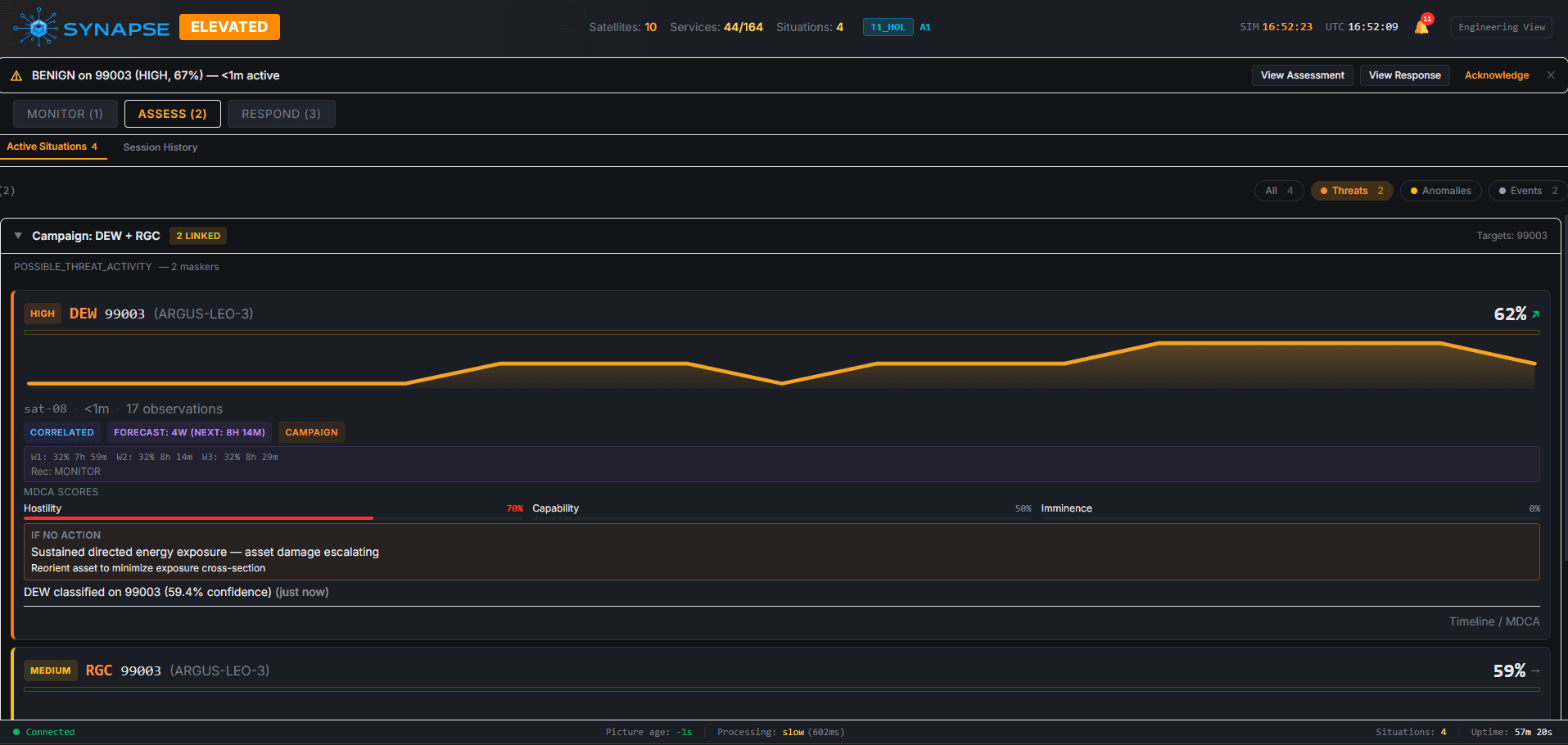
Threat Assessment — MDCA classification pipeline
Engineering View — Pipeline diagnostics
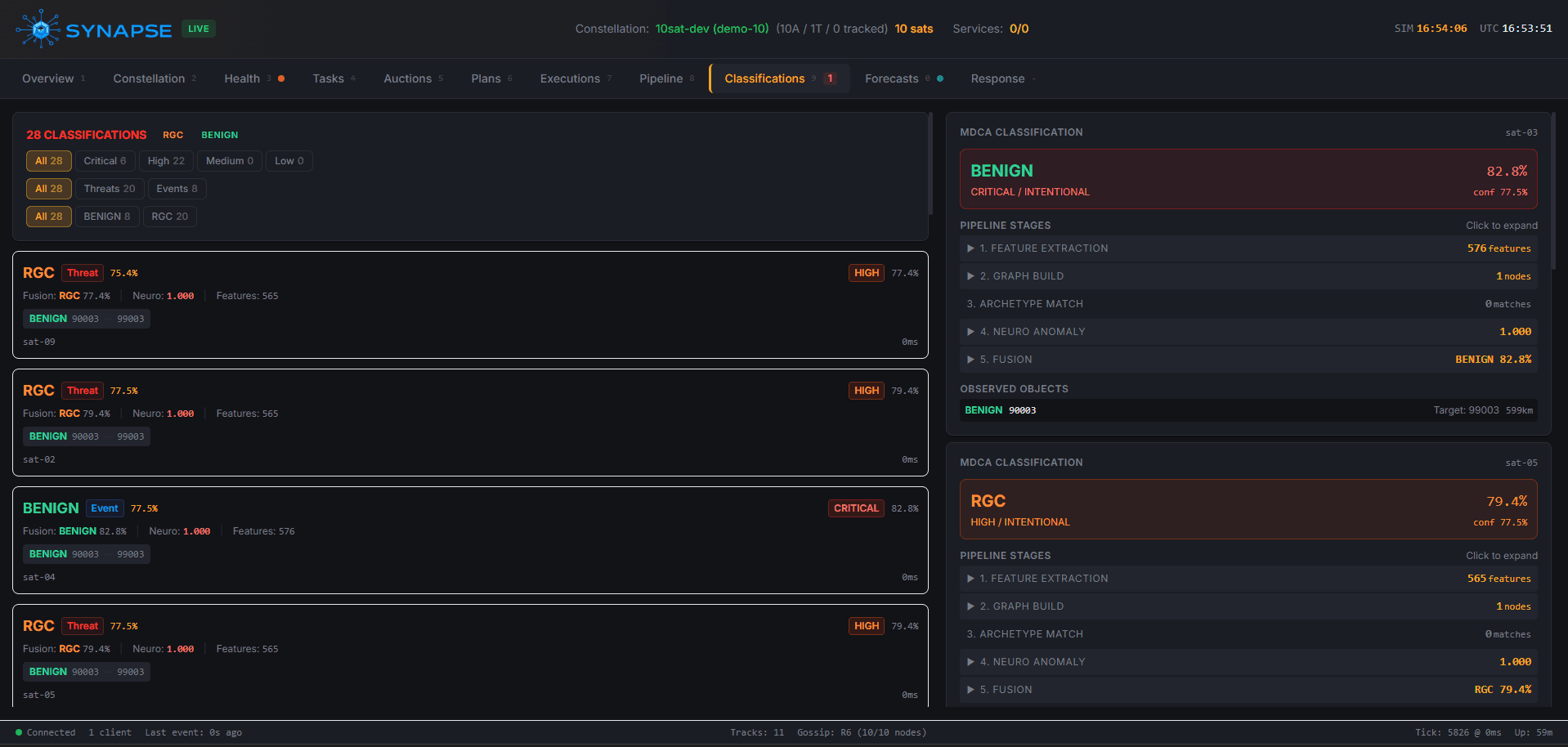
Classification — ML fusion results
What This Means in Practice
Ground Link Goes Down. Mission Doesn't.
Orbital gap. Latency spike. Jammed uplink. It doesn't matter. Your constellation keeps operating, keeps coordinating, keeps executing the mission.
Events Met at Machine Speed
A close-approach maneuver doesn't wait for a ground pass to be classified. Detection, classification, and coordinated fleet response happen in seconds — not hours.
From 10 Satellites to 1,000
Every satellite you add increases capability, not complexity. The same coordination layer that runs 10 nodes runs a thousand. No additional ground infrastructure required.
Prove It Before You Fly It
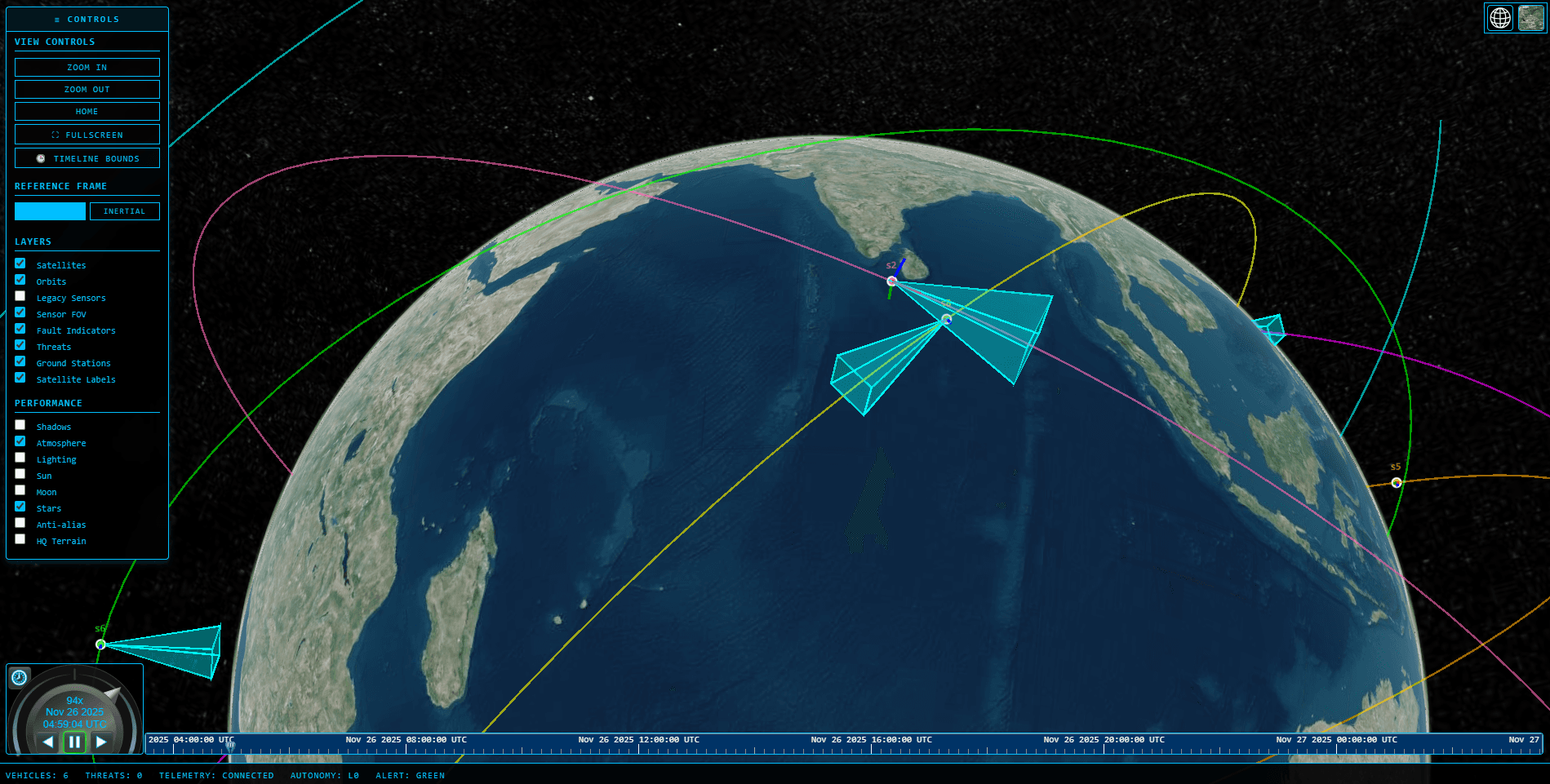
SIMULACRUM
Your constellation faces a conjunction event, an anomalous close approach, or a directed energy attack at 3 AM. How does it respond? SIMULACRUM answers that question before you ever reach orbit — running the complete SYNAPSE stack against realistic operational scenarios at full fidelity.
Who This Is For
Three Markets, One Platform
The Sentinel Advantage
Born in Orbit, Not Ported from the Ground
SYNAPSE wasn't adapted from ground-based C2. It was designed as flight-software adjacent infrastructure — a modular coordination layer that deploys alongside existing systems to distribute authority without rewriting anything.
One Platform. Sensor to Response.
Detection, classification, decision, and execution in a single integrated stack. No stitching together third-party tools. No integration risk. It just works.
Total Decision Transparency
Every autonomous action is logged with full context — what happened, why, what alternatives were considered. Deterministic replay lets you audit any moment in the mission.
Ground sets mission intent. SYNAPSE ensures execution continues.